How Glass Recycling Works
Behind the purple bin lies one of the most technologically advanced glass processing facilities in North America. See how science, engineering, and passion turn community waste into valuable raw material.
Ripple gathers over 800 tons of glass every single week from residents and businesses in the KC area and surrounding region, processing it into usable materials for remanufacturing as new glass, insulation, countertops, and more.
In Four Easy Steps, You Can Start Recycling Your Household Glass
Recycling glass at home is simple, accessible, and 100% free for everyone in our community. Here is all you need to do:
Collect Your Glass
If you have glass bottles, jars, drinking containers, vases, candle jars, and more, you can recycle! Clear, green, amber, or blue — all food and beverage containers are accepted.
Store at Home
Start storing your glass at home! Find a spot in your garage, under your sink, or anywhere convenient. Our durable home bins make it easy and convenient! A cardboard box or plastic tote also works great.
Locate a Bin
Find a purple bin near you! All Ripple Glass neighborhood bins are free to use and open to the public 24 hours a day, 7 days a week.
Drop & Go
Drop your glass in the bin and we’ll take it from there. No need to remove labels or separate colors — our high-tech processing facility handles every step downstream.
Where Does Your Recycled Glass Go?
The glass is brought to the Ripple Glass processing facility where it is cleaned, sorted by color, crushed, and sized to meet the precise technical specifications of its end-users.
Re-Melted into Brand-New Beer Bottles
Brown and amber glass is separated out and broken down into clean, uniform 2-inch cullet pieces. This furnace-ready material is transported to regional bottle manufacturers to be re-melted into brand-new beer bottles and beverage containers!
Transformed into Eco Fiberglass Insulation
The remaining clear and colored glass is crushed down into a coarse sand-like consistency and transported just across the state line to Owens Corning in Kansas City, Kansas, where it is spun into high-performance fiberglass building insulation.
Inside the Kansas City Processing Plant
Processing over 800 tons of glass each week requires continuous motion, specialized heavy machinery, and precision camera technology. Our Kansas City plant operates with zero landfill waste generated in our processing streams.
From Bottle to New Product in 6 Steps
Follow an empty wine or beer bottle from your neighborhood purple bin through our full industrial recovery cycle.
Drop-Off & Hauling
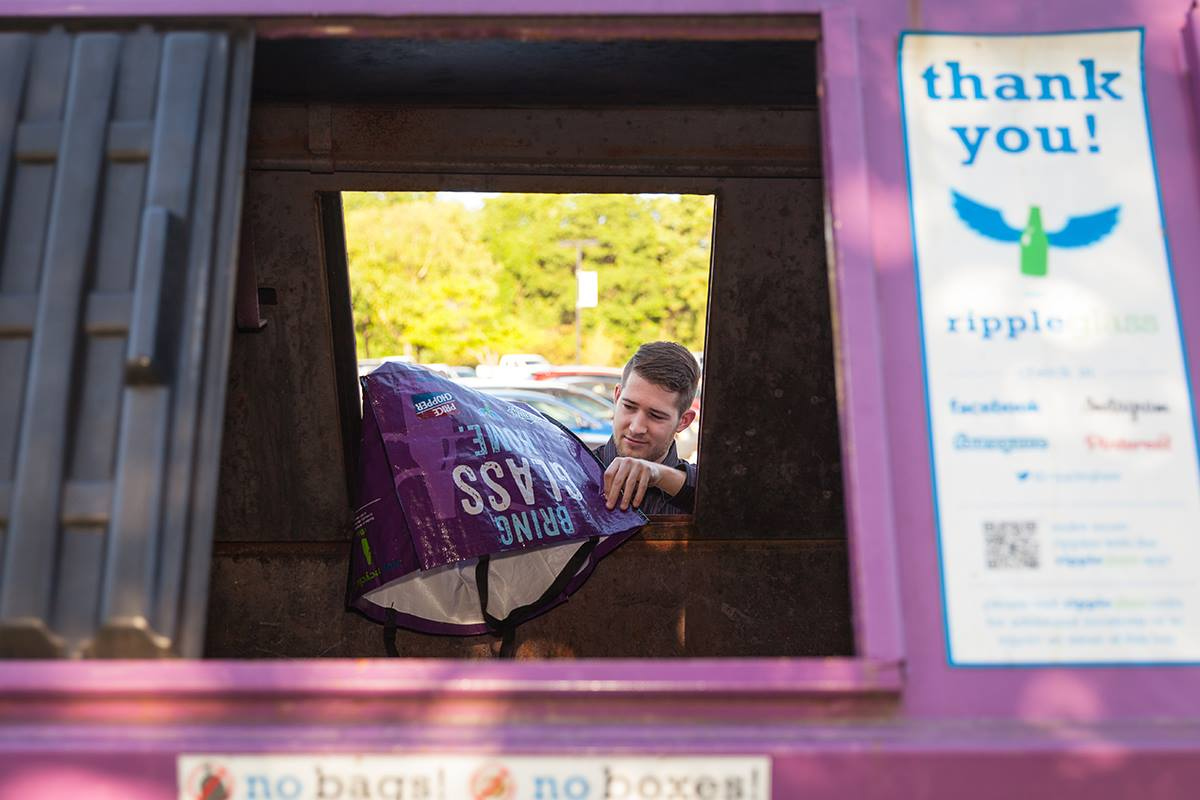
Recyclers deposit glass into hundreds of neighborhood purple bins and business rolling carts. Our dedicated haulers use heavy hydraulic roll-off trucks to collect and transport containers to our Kansas City facility.
Intake & Screening
Glass is tipped onto the facility floor and pushed into intake hoppers. A vibrating grizzly screen and rotating trommel loosen debris and sift out plastic bags, six-pack rings, and cardboard packaging.
Drying & Initial Crush
Material enters a high-temperature rotary drum dryer, eliminating leftover moisture and releasing paper label adhesives. It then enters an initial impact crusher to break glass down to manageable fractions.
Magnetic Separation
High-strength neodymium cross-belt magnets automatically extract steel bottle caps and jar lids. Downstream eddy current separators induce magnetic fields to reject non-ferrous aluminum neck rings.
Optical Color Sorting
High-speed cameras scan individual glass fragments moving across conveyor belts at 10 feet per second. Targeted, ultra-precise air jets instantly puff clear (flint) glass into a dedicated high-value stream away from amber and green.
Precision Sizing & Delivery
Glass is milled through secondary sizing screens into clean, furnace-ready cullet. The finished material is loaded into railcars and dump trucks bound for Owens Corning insulation and bottle manufacturing plants.
The Beauty of 100% Circular Glass
Unlike plastics which degrade and "downcycle" after one or two uses, glass can be melted down and recycled an infinite number of times without any loss in quality, purity, or strength.